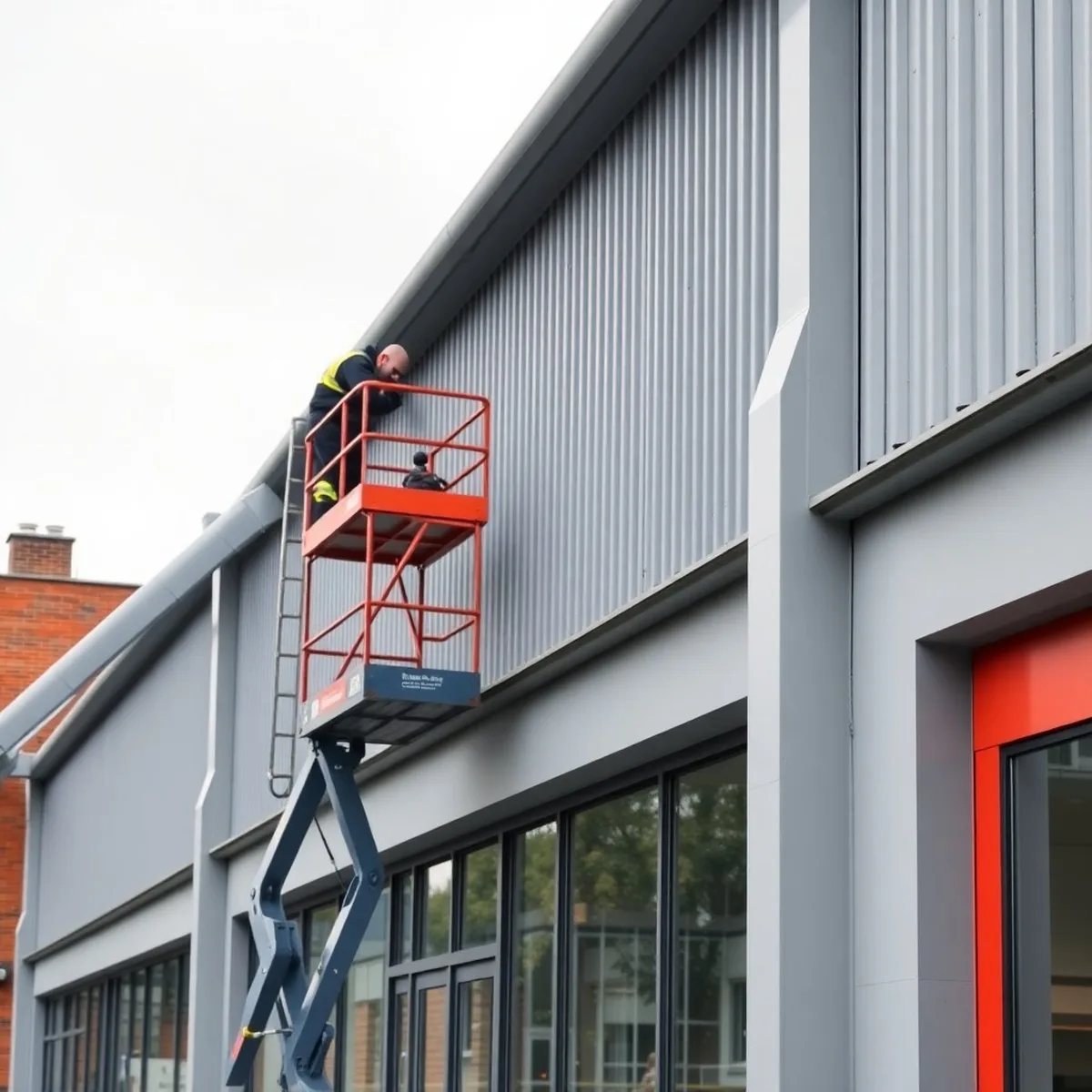
Commercial gutter cleaning is a different job from clearing the gutters on a house. The buildings are larger, the gutter systems are often hidden from view, access needs planning, and the consequences of a blockage — stock damage, closed premises, insurance claims — are far more expensive. That’s why most businesses treat gutter clearance as planned maintenance rather than an emergency call-out.
We clean gutters across West London, and we work on commercial and industrial properties as well as homes. Here’s what facilities managers, business owners, and managing agents should know.
Why Commercial Gutters Fail Differently
On a house, an overflowing gutter stains a wall and eventually causes damp. On a commercial building, the failure mode is often more dramatic, because of how the gutters are designed.
Box gutters hide their problems
Many commercial and industrial buildings use box gutters — deep, rectangular channels that run behind parapets or along valleys between roof sections. Unlike domestic guttering, they’re usually invisible from the ground. Consequently, nobody sees the leaves, moss, and silt building up until the gutter overflows.
However, when a box gutter does overflow, the water frequently has nowhere to go but inwards. Instead of spilling harmlessly down an outside wall, it can back up under the roof covering and appear inside the building — over stock, equipment, ceiling tiles, or trading areas. For example, a blockage that would be a cosmetic nuisance on a house can close part of a commercial unit.
Bigger roofs collect more debris
Large roof areas drain enormous volumes of water through relatively few outlets. As a result, a single blocked outlet affects a much larger catchment than on a domestic property, and standing water builds up faster and deeper. Since standing water adds significant weight, prolonged blockages also stress the gutter structure itself.
Access: How Commercial Gutters Are Cleaned Safely
Access is usually the biggest practical question on a commercial job, and it’s where professional equipment earns its keep.
For a large share of buildings, we use a vacuum-based system — the same SkyVac approach we use domestically — operated from ground level using carbon-fibre reach poles. Because the operator stays on the ground, there’s no need for scaffolding on many buildings, no ladders against cladding, and far less disruption to whatever is happening below. A camera on the pole lets us inspect the gutter channel as we clear it.
Where roof access is genuinely required — deep parapet box gutters, valley gutters on large industrial roofs — the job is planned with appropriate access equipment and safety measures. Every job starts with a free survey, so the access method, timing, and price are agreed in writing before any work begins. If you’d like more detail on the vacuum method itself, see our explainer on SkyVac gutter cleaning.
Planned Maintenance Beats Emergency Call-Outs
For commercial premises, the strongest argument for a maintenance schedule is financial. A planned clean is a predictable, budgeted cost. An internal leak over stock or IT equipment is not.
A sensible general approach looks like this:
- At least one clean per year, typically after autumn leaf fall, for most commercial buildings.
- Two visits per year where the building sits under or near mature trees — common across Uxbridge, Hillingdon, and Southall business areas — or where box gutters give no visual warning of buildup.
- Inspection included with every clean, so failing joints, corrosion, or ponding are reported before they become leaks.
- Consistent scheduling, so the roofline is never more than a year from its last inspection.
Additionally, regular servicing tends to make each visit cheaper and quicker, because debris never gets the chance to compact into the heavy, silted mass that slow-draining gutters accumulate over several years.
Documentation: What Businesses Should Keep on File
For commercial clients, the paperwork matters almost as much as the cleaning. Insurers, landlords, and managing agents increasingly expect evidence that a building is being maintained, and gutter maintenance records are a simple part of that picture.
We support this in three ways. First, we provide before-and-after photos with every job, which is genuinely useful on commercial buildings where nobody can see the gutters from the ground — the photos are often the only visual record of the gutter’s condition that exists. Second, we provide free written quotes for the work and for any repairs identified, giving you a dated record of the building’s roofline condition. Third, we provide written documentation for your contractor records.
That combination — photographic evidence and written reports — is exactly what a facilities manager needs on file if a question about building maintenance ever arises.
What’s Included in a Commercial Gutter Clean
Every commercial job with us includes:
- A free initial survey and written quote
- Clearance of all gutters, outlets, and accessible downpipes
- Camera inspection of concealed runs where the vacuum system is used
- Before-and-after photos of the work
- A report of any defects found, with a written quote for repairs
Repairs we carry out are backed by our 12-month workmanship guarantee. You can read more about our approach on our gutter cleaning service page.
Frequently Asked Questions
Do you clean gutters on commercial and industrial properties?
Yes. Alongside domestic work, we service commercial and industrial buildings across West London, including box gutters and larger roof systems. Every commercial job starts with a free survey.
What is a box gutter?
A box gutter is a deep, rectangular gutter channel built into the roof structure, typically running behind a parapet wall or along a valley between roof sections. Because it’s hidden from the ground, it needs scheduled inspection rather than waiting for visible signs of blockage.
How often should commercial gutters be cleaned?
At least annually for most buildings, and twice a year where there’s heavy tree cover or where box gutters conceal debris buildup. A regular schedule keeps each visit quicker and prevents internal leaks.
Can you provide documentation for our insurance or landlord?
Yes. We provide before-and-after photos with every job and free written quotes for any work — everything you need for your maintenance records.
Responsible for a commercial building in West London? We serve Uxbridge, Harrow, Hayes, Hillingdon, Slough, Southall, West Drayton, and Windsor, with same-week appointments where possible. Request a free quote form and we’ll respond within 2 hours during business hours (Mon–Fri, 8am–6pm).
Related reading: SkyVac Gutter Cleaning Explained | How Often Should Gutters Be Cleaned?
Tags:
Related Articles
Autumn Gutter Cleaning Checklist
A practical autumn gutter checklist for UK homes: check for leaf build-up, test downpipes, inspect fascias and book a clean before winter rain arrives.
Read more Tips & AdviceThe Best Time to Clean Gutters in the UK
Late autumn, after the leaves have fallen, is the best time to clean gutters in the UK — with early spring a close second. Here's why the timing matters.
Read more